GG
Home / CS2 Gambling Sites / Case Battle Sites
Best CS2 Case Battle Sites in 2026
A case battle is a player-versus-player mode: two or more people open the same cases at once, and a winner rule decides who takes the combined skins. This page compares CS2 operators that run case battles and already hold a published SkinRake evidence profile. We record battle formats, published fees, bot-fill options, and provably fair documentation; account-side results and item valuations stay unverified unless a review documents a test. 18+ only — always check the law where you live.
CS2 Case Battle Site Reviews
14 CS2 case battle partner sites reviewed. Every site here is a SkinRake referral partner, so we earn a commission if you sign up through our link. Sites are listed in review order, never by commission rate. Operators we researched without a partnership are not listed, and their profiles stay in the review directory.
14 CS2 case battle partner sites reviewed.
GG
BL
BloodyCase
CA
CaseBattles
CA
CaseHug
CG
Chicken.gg
GG
GGSkins
PG
Plunder.gg
CG
Clash.gg
DA
DaddySkins
DA
DatDrop
FA
Farmskins
HE
Hellcase
KE
KeyDrop
RG
Rain.gg
Prefer Rust? RustCasino's profile documents Rust case battles — see the Rust gambling sites comparison. For the full CS2 line-up, open all CS2 gambling sites.
Battle rules we record
Before an operator appears above, we look for a documented battle format: player and team count, case sequence, entry cost, the winner rule, any lowest-wins "crazy" variant, and whether the pot is split. Login-only or match-specific behaviour stays unverified unless separately documented.
Fees and bot-fill
We note the published rake or how cases are priced against their drop value, plus whether bot-fill is documented and can be disabled. A fair-play badge is not evidence on its own; the operator should explain the seed, nonce, and verification steps clearly.
Profiles in progress
An operator earns a place here only after official payment, fairness, and battle-rule pages support a public profile. Sponsorship never lowers that threshold, and a listing is not a payout guarantee.
What a case-battle arena shows before you join
A dated public interface observation, separate from account-side results and item valuations.
Reading the battle lobby
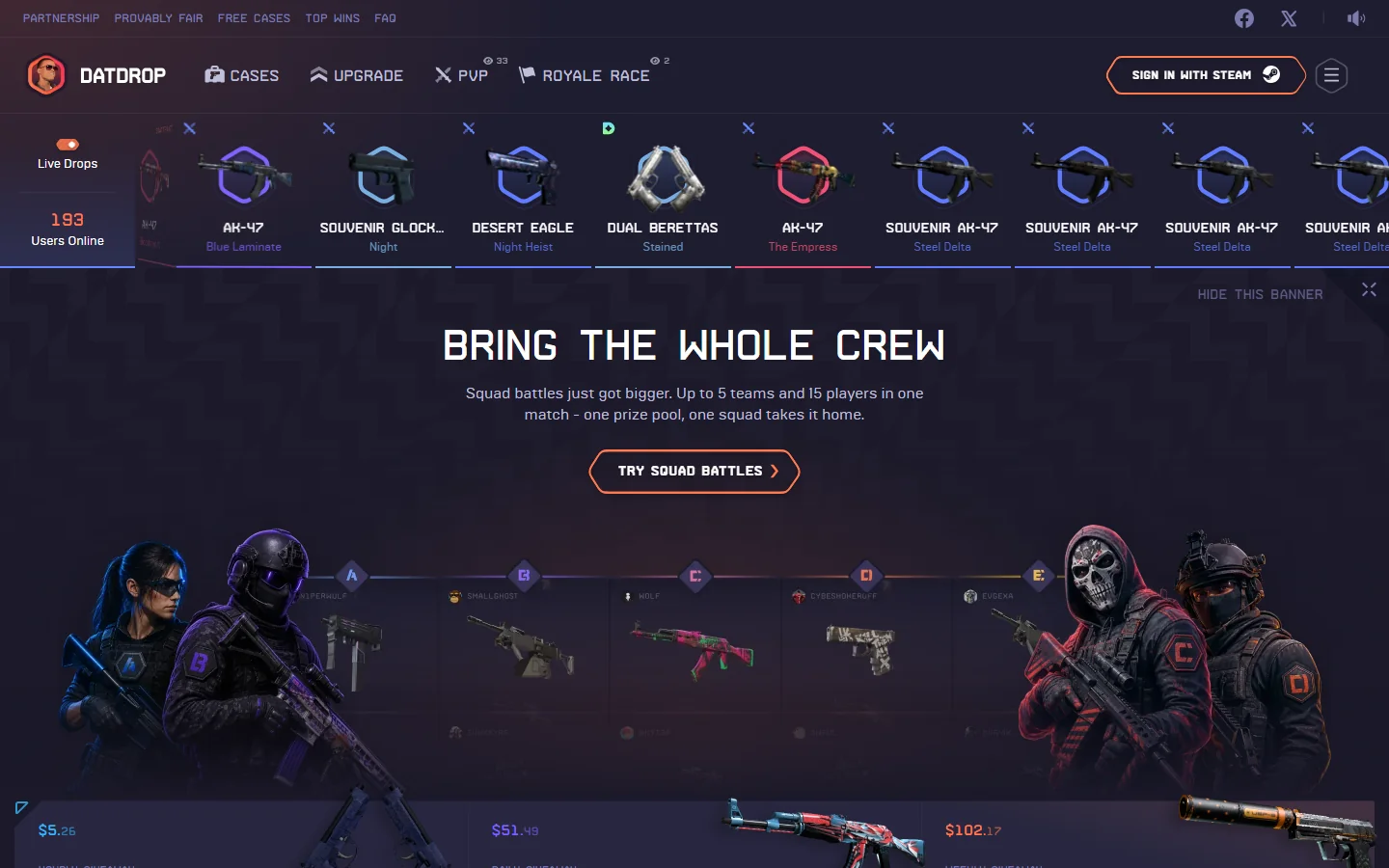
The DatDrop homepage viewed on 16 July 2026 presented a live drop feed, a squad-battle promotion for up to fifteen players across five teams, an upgrader, and race events. A lobby like this exposes the player and team count, the case sequence, and the entry cost up front. The screenshot documents those interface fields; it does not establish aggregate opening outcomes, so per-case probabilities must be checked on the operator's own odds page.
Before committing, record four fields from the battle page: the winner rule (highest or lowest total), the fee or rake, the bot-fill setting, and how the site values each unboxed item. Two battles that look identical can differ sharply once the fee and item-valuation method are compared. Missing probabilities or pricing remain evidence gaps under the research checklist below.
How CS2 Case Battles Work
In a case battle, each participant pays the same entry and the site opens an identical sequence of cases for every player at the same time. As the cases open, the interface tallies the market or site-assigned value each player unboxes. When the sequence ends, a winner rule awards the combined items — usually to the highest total. Because every player faces the same cases, the mode feels like a race, but the underlying odds are still the published case odds, and the house takes its edge through a fee, case pricing, or both.
The current review set advertises several recurring battle labels. Rules, fees, and probabilities differ by operator, so check the exact battle page rather than assuming one shared format across sites.
Case Battle Formats and Rules
1v1 and 2v2
Two players, or two pairs, open the same cases. In team modes the winning side usually splits the combined pot. Record the split rule before joining so you know what a win actually pays.
Group and squad battles
Three or more players, sometimes grouped into teams of several each, compete for one pot. More entrants raise the pot and the variance. Confirm the maximum player count and how ties are resolved.
Crazy (lowest-wins) mode
Crazy mode inverts the winner rule so the lowest total takes the pot. It changes strategy, not the house edge, so still check the fee and the item-valuation method the operator applies.
Bot-fill and shared draws
Some sites let a battle start against a house bot when human players are short. Check whether bot-fill is documented, how the bot is funded, and whether you can turn it off before you commit an entry.
Fees, Rake, and Expected Value
A case battle can carry a house edge in two places: an explicit rake taken from the pot, and the gap between a case's price and the expected value of its drop table. Either mechanism means the pot returned to players is smaller than the total staked. When an operator publishes both per-case probabilities and dated item values, you can estimate a case's expected value by multiplying each drop probability by a current, independently sourced price and summing the results, then comparing that figure with the case price. On comparable inputs, a case returning an estimated $0.90 per $1 is less costly than one returning $0.80, but both remain estimates. Recalculate when prices or inventory change, and do not substitute an operator's internal item value for a cash-market price without showing the difference.
How We Research Case Battle Sites
A CS2 case-battle profile compares the documented battle format, the published fee or rake, bot-fill behaviour, the fairness workflow, advertised skin and crypto rails, and the operator named in official terms. Login-only limits and transaction outcomes stay unverified without a documented test, and commercial relationships do not lower the publication threshold. SkinRake did not place a battle or test a withdrawal for this comparison; each linked review states what its evidence does and does not cover.
Are Case Battles Provably Fair?
For a house-run battle, a public verifier may let you recompute each case result from a disclosed server seed, client seed, and nonce. A matching recomputation checks consistency with those inputs. It does not independently establish that the inputs were unbiased, that items were valued at a fair market price, or that a withdrawal will arrive. The NIST SHA-256 glossary defines the hash terminology some operators use. Fairness documentation is most useful when a server-seed commitment appears before the battle, the client seed can be changed, and the published calculation lets a reader reproduce the outcome. See our full provably fair guide for how to run the check without mistaking consistency for safety.
Deposits and Withdrawals for Battles
Battle entries are funded from your site balance, which operators credit from Steam-item, cryptocurrency, or card deposits. Record the credited skin value, the processor, the network, the minimum, and the withdrawal method separately, because a battle win pays into the same balance you later try to cash out. Check Steam's recommended trading practices before relying on a timing claim, and compare any quoted item value against a skin marketplace or trading service before accepting a trade. If you would rather build a balance without depositing, start with our guide to earning free skins.
Sources used for this comparison
Official and public resources checked 16 July 2026. Each source supports only the cited rule or technical description; it does not endorse an operator.

CS2 Case Battle FAQ
A case battle is a player-versus-player mode where two or more people open the same sequence of cases at the same time. The site totals each player's unboxed value, and a winner rule decides who takes the combined items. Read the exact rules and fee before entering, because formats differ by operator.
In the standard format the highest total unboxed value wins the whole pot. Some operators also offer a lowest-total variant, and team modes split the pot among the winning side. Confirm the winner rule and any split rule on the operator's battle page before you join.
Crazy mode inverts the winner rule so the lowest total unboxed value wins instead of the highest. It changes the strategy but not the underlying house economics, so still check the published fee and the item-valuation method the operator uses.
Many operators keep a percentage of the pot or price the cases above their expected drop value; the effect is the same house edge either way. A published rake or fee is one signal to record, but a battle can still be negative expected value even when no separate fee is shown.
Bot-fill lets a battle start against a house bot when not enough human players join. Check whether an operator documents bot-fill, how a bot is funded, and whether you can disable it, because it changes who you are actually competing against.
Some operators publish a seed and nonce workflow that lets you recompute a battle's case results from disclosed inputs. A matching recomputation checks consistency with those inputs; it does not establish unbiased inputs, correct item valuation, or reliable withdrawals. SkinRake did not place a battle to test any operator.
You win the pot as CS2 skins or site balance, which some operators let you withdraw as items or crypto that can later be sold. Converting through a marketplace or exchange adds fees and price spread, and repeated play in a negative expected-value mode is expected to lose value over time.
Battle-rule evidence sets the publication threshold
Some outbound links may earn SkinRake a commission. A case-battle operator is published only when its current battle rules, fee or rake, payment terms, and fairness documentation support a public profile. Commercial terms do not replace missing evidence, and none of these checks makes gambling safe.
SkinRake has not established account-side battle outcomes, item valuations, or withdrawal timing unless a review says a separate test occurred. Read the affiliate disclosure and research method.